

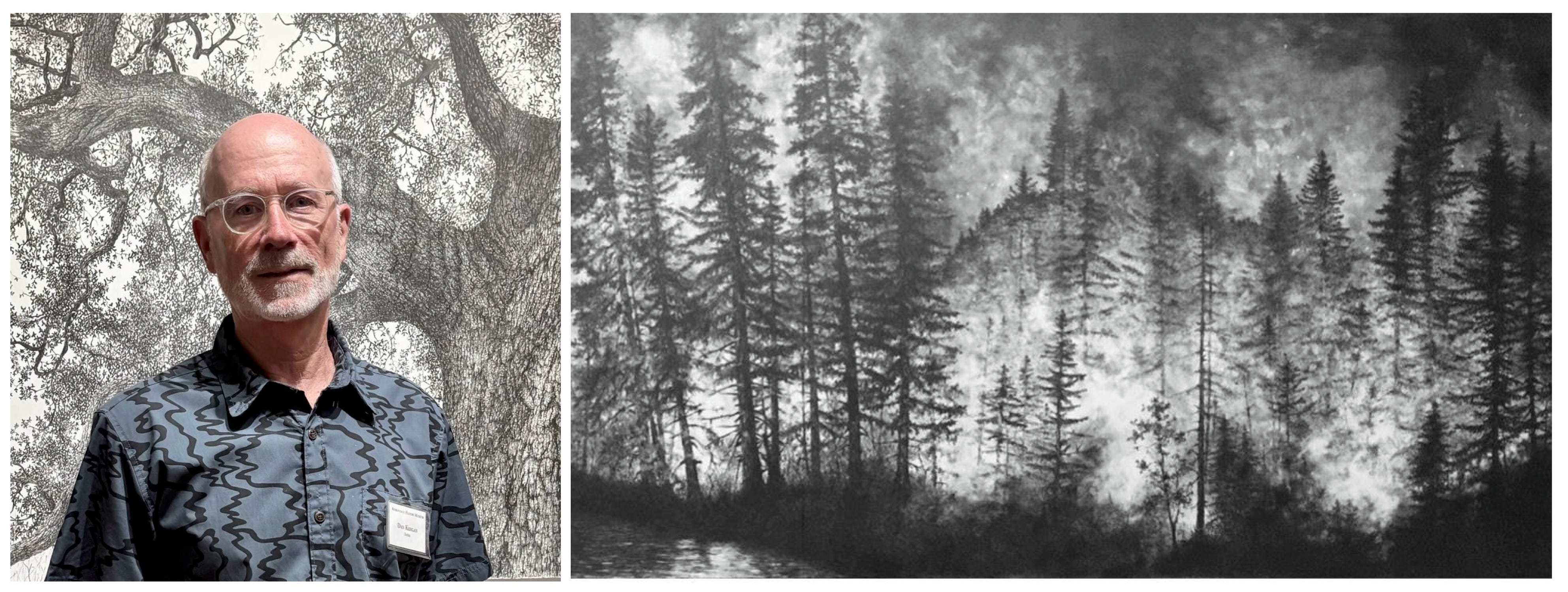
“The Elements: Images of Hope” is an exhibition of works on paper by Dan Keegan at the Adirondack History Museum in Elizabethtown, New York through October 11, 2025. The museum describes the show as,
“. . . based on the four elements - earth, air, fire, and water. It is the idea of the natural harmony among these elements that led to the creation of this exhibition, addressing climate crisis and the disharmony we are experiencing today. The works in this exhibition are intended to be signifiers of the fragility of our planet and that we can and must come together to address pressing issues.”
Keegan’s meticulous graphite drawings might be classified as graphic paintings in the tradition of East Asian suiboku landscapes, or Dutch Golden Age penschildern. First impressions of benign beauty lure the viewer into beholding visions of ecological calamity, and the resilience of nature.
I spoke to Dan Keegan about his new body of work.
James McElhinney— What was the genesis of the artworks now on view at the Adirondack History Museum?
Dan Keegan— I was always interested in nature and always interested in photography. Many of my earlier drawings started out as composites of my photographs. I would cut and paste and create multiple views and inversions of things, of images based on photographic images. When I look back at my sculptural work, much of it had to do with the environment and also combined images. There are some pieces from the early 1990s that were about the health of the planet.
James McElhinney— Before environmental art became fashionable.
Dan Keegan— Right. And then I realized too that my drawings tended to gravitate toward this idea of nature, nature challenged, nature being put in check, and its interactions with humankind. That led to this current body of work, which started during COVID. Coming out of Covid I began doing large scale environmental drawings having to do with the elements of earth, air, fire, and water.
James McElhinney— The idea of composites is interesting because Frederick Church and Albert Bierstadt produced these monumental landscape paintings that were the IMAX movies of their time. People thought they were real places, but they’re composites. Bierstadt's painting of Mount Rosalie in the Brooklyn Museum is fiction. I've been to that mountain. I know where Bierstadt stood to capture most of that image, but that snowy peak wreathed in clouds is pure invention.
Dan Keegan— Pure invention. My images are invented from photographs or in some cases images from the internet. But they are not plein air drawings. Plein air artists would often go back to their studios to do finished works based on sketches made in the field. That’s when the magic happened as you noted.
James McElhinney— Their desire was neither to be literal, nor limited by mere imitation and factual reportage, but to convey a sense of wonder and awe.
Dan Keegan— What I discovered was that the viewer is having an experience with the finished image and what it represents. How it was put together is of lesser consequence really because what matters most is the experience with the finished work.
James McElhinney— Well, human experience is a composite. That's one of the problems.
Dan Keegan— Good point. And in that sense my drawings are references to much bigger issues and hopefully are catalysts for viewer experiences and emotions.
James McElhinney— Humans don't experience nature the way a camera records it. Photographers such as Ansle Adams and Jerry Uelsman pushed the envelope with darkroom magic. There's a great video of David Hockney explaining that human beings engage with multiple focal points, how looking is a sequential experience—panning, scanning, and eye tracking that can't be captured in a static image.
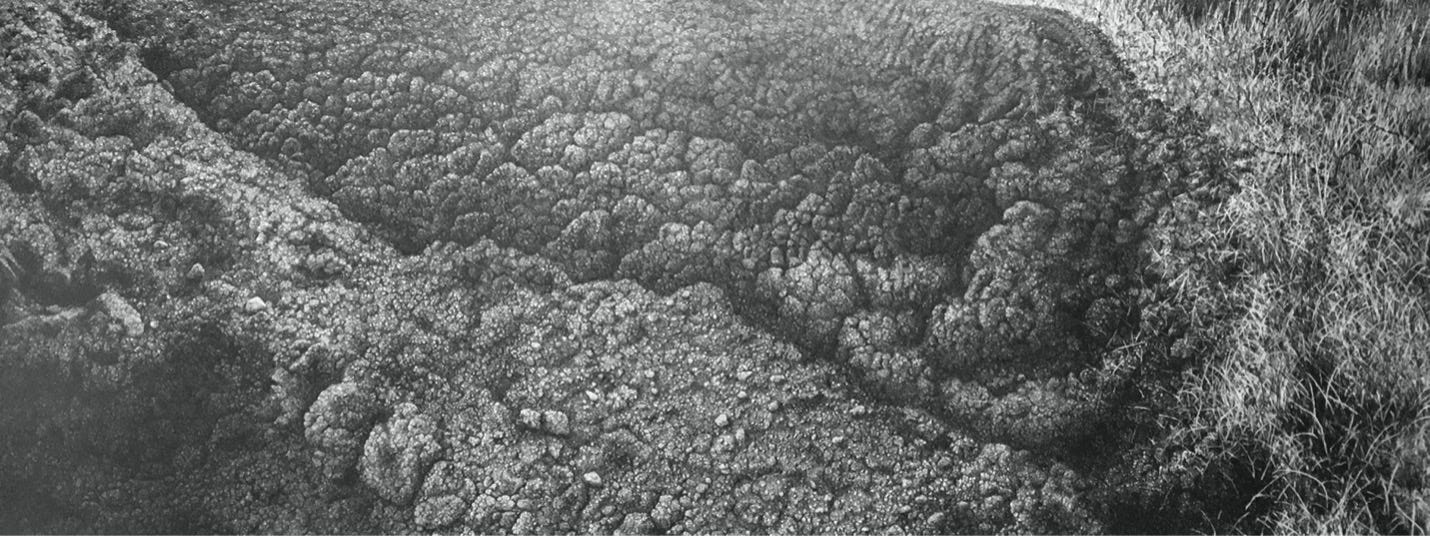
Dan Keegan— Yeah. And in that sense, a drawing can be a symbol for something. It can conjure up memories within the viewer of their own experiences with nature. It’s not representative so much as it brings up our own personal life experiences and how we connect or how using this as a catalyst, as a starting point, creates that sense of memory, of joy, or of wonderment of what it represents on the one hand, but also the notion of process and how it was made and created. And a third piece of this—the third leg of that stool, is how it gets us to a point of standing still and looking and reflecting. For me that's the exciting part about experiencing art; to simply stand before it and soak it in, to engage, wonder and think.
James McElhinney—Physicists have now proposed the idea that everything is happening now, all at once, everywhere, and that linear time is an illusion.
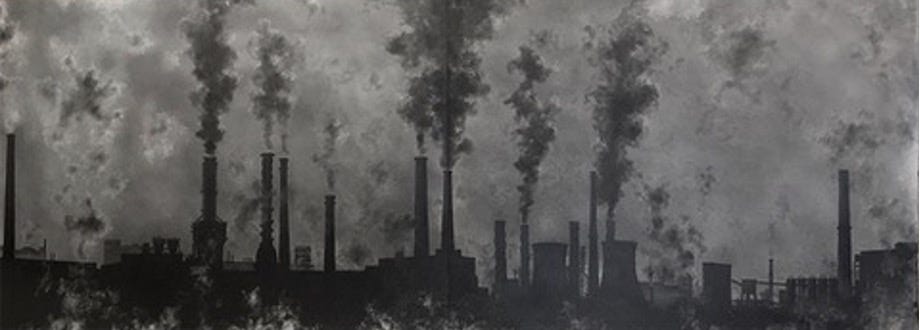
Dan Keegan— Yes, but we know that we are here now experiencing something on this planet. What fascinates and horrifies me is how we as a species could be doing so much harm to it. How is it that we can have an area of plastic garbage floating in the ocean bigger than the state of Texas? And the Great Pacific Garbage Patch is only one of five major garbage zones that are floating in the oceans. How can we allow that to happen if we look at the data and the facts and recognize that the average depth of the ocean is only 12,000 feet? That's two and a half miles. And it's sustaining all life on this planet. 50% of the oxygen on Earth comes from the microplankton in the ocean. How is it that we can allow that to be destroyed by our own garbage? I don't understand but aren’t we all violators? How is it that we can pollute the air and burn fossil fuels when the breathable atmosphere is barely four miles in thickness? Yet I drive my car. You probably read some of those facts that I put in the show to try to get us to understand that this is an extremely fragile environment. I needed to limit the amount of climate change information in the exhibition because I couldn't fill the whole museum with data. I probably should have, but I settled on a few touchstones to go with the images. I can't remember what the source of this was but it was explained to me that if you think about the earth as the sphere that it is floating out in space. And we think about the vast extremes of the Himalayan mountains or the depths of the oceans, the surface of the earth, that difference of elevation and surface below the ocean would be no more than your fingerprint in terms of those ups and downs, peaks and valleys relative to earth’s diameter. That's how smooth this surface is. Or said another way, it’s how 8,000 miles in diameter translates to a mountain peak that's only a few thousand feet. Earth’s surface is so thin, so fragile. And then move out to the vastness of the universe and think about this planet, part of a solar system that is part of an arm of the Milky Way that in itself is rotating in the universe that in itself is moving through the universe. The earth is so tiny and insignificant on the one hand, yet it is so precious and special to us as human beings.
(To be continued)
—James Lancel McElhinney © 2025
READ “Images of Hope Part Two” HERE
James Lancel McElhinney is a visual artist and author of books on art, articles, and essays published in Adirondack Explorer, American Arts Quarterly, Fine Art Connoisseur, Hudson River Valley Review, Orientations, and other periodicals. He is a member of the Hudson River Museum Board of Trustees and the Arthur Miller Foundation Artist and Industry Council. McElhinney resides in the Champlain Valley and Manhattan with his wife art historian Dr. Katherine Manthorne.
Downloadable PDF of Dan Keegan’s “The Elements: Images of Hope”
Many thanks for your supporting as a subscriber! Please let me know what you think of these articles, and what kind of content you hope to see more.